

Rosehip oil or prickly pear seed oil: which one should you choose for your face?
Rosehip oil or prickly pear seed oil? Both are counted among the “precious” face oils, and they are often presented as interchangeable. They are not.
The short answer: rosehip provides omega-3s and carotenoids, costs less and has been tested in a few human trials. Prickly pear stands out for its dry texture, its richness in linoleic acid and sterols, and its better resistance to oxidation. It is also far rarer.
Two “precious” oils, two plants
The seeds of the nopal (Opuntia ficus-indica)
Prickly pear oil is extracted from the tiny seeds of the fruit of a cactus, the nopal or prickly pear cactus. In the ingredient list (INCI), it is called Opuntia Ficus-Indica Seed Oil.
The word “Seed” matters: it signals a seed oil, not a simple infusion of flowers or cactus pads. For the history of the plant and how the oil is made, read our article to learn all about the origin and production of prickly pear seed oil.
The wild rose, or rather the wild roses
“Rosehip” does not refer to a single plant. The oil comes from the seeds of the fruits (rose hips) of several wild roses, mainly:
- Rosa rubiginosa, the Andean “rosa mosqueta”;
- Rosa canina, Europe's common dog rose.
Their composition is not identical. Read the INCI: Rosa Rubiginosa Seed Oil or Rosa Canina Fruit Oil will tell you which species you are buying.

Composition compared: what does each oil contain?
Both oils are dominated by linoleic acid (omega-6). Rosehip may contain a little more omega-3. Both are rich in vitamin E and plant sterols, with wide variations depending on origin and pressing.
These variations are real: the same oil can vary twofold from one harvest or region to another. Be wary of single, very precise figures. Here are the ranges published in scientific journals.
| Component | Prickly pear | Rosehip |
|---|---|---|
| Linoleic acid (omega-6) | 57 to 74% | about 41 to 54% |
| Alpha-linolenic acid (omega-3) | low | about 17 to 39% |
| Oleic acid (omega-9) | about 13 to 19% | about 16% |
| Vitamin E (tocopherols) | 500 to 680 mg/kg, mostly in gamma form | up to 1,125 mg/kg depending on the oil |
| Plant sterols | 8,000 to 11,100 mg/kg | up to 6,485 mg/kg |
| Carotenoids | poorly documented | up to 108 mg/kg |
Sources: Nounah et al. 2024; Kadda et al. 2021 and 2026; Grajzer et al. 2015; Rincón-Cervera et al. 2016; Moreno Giménez et al. 1990 (details at the end of the article).
Key takeaways:
- Prickly pear stands out for its linoleic acid and sterol content.
- Rosehip stands out for its omega-3s and carotenoids, which give it its orange colour.
- On vitamin E, studies do not allow us to separate the two oils. Claims such as “the richest in vitamin E” do not hold up against the measurements.
To learn more about these fatty acids, read our article on omega-3, 6 and 9 in plant oils.
What about rosehip's “natural retinol”?
You often read that rosehip contains retinoic acid, the active form of vitamin A. This figure has been circulating for a long time, but we have found no recent published analysis that confirms it.
Its colour comes from carotenoids, pigments the body can convert into vitamin A, but which are not retinol. Rosehip remains a good oil; it simply is not a retinoid.
Texture, colour, scent: how it feels on the skin
This is often what decides things day to day. Prickly pear oil is fluid, pale yellow-green, and absorbs within moments, leaving a dry touch. Rosehip oil is slightly richer, amber to orange in colour, with a faintly plant-like scent, and often leaves an oily film.
In practice:
- Combination skin, or need for a clean finish under make-up: prickly pear disappears faster.
- Dry skin, evening routine: rosehip leaves a more comfortable film.
- In both cases, 2 to 3 drops are enough for the whole face. Beyond that, any oil can look shiny.

Shelf life: which one oxidises faster?
Rosehip oil. Its omega-3s are among the most fragile fatty acids: in contact with air, light and heat, they oxidise and the oil turns rancid. Prickly pear oil, low in omega-3s, ages more slowly.
Manufacturing quality matters as much as the plant. A 2025 study observed a sharp rise in oxidation in rosehip oils depending on the extraction method. Conversely, good-quality cold-pressed oils showed reasonable stability.
Our advice, valid for both:
- choose an opaque or amber bottle, tightly closed;
- keep it away from heat and light;
- finish it within the months after opening;
- throw it away if it smells rancid: an oxidised oil can irritate the skin.
Why is prickly pear oil so expensive?
Because its seeds contain very little oil. According to industry estimates, it takes about one tonne of fruit to obtain 30 to 50 kg of seeds, and a single litre of cold-pressed oil. Rosehip, harvested and pressed on a larger scale, remains far more affordable.
Analyses confirm it: depending on origin and process, prickly pear seeds yield from a few percent to around twelve percent oil. Add to this the harvesting of fruit covered in spines, separating the seeds and drying them.
This price has a downside: it attracts imitations. We come back to this below.
Which one to choose for your needs?
Choose prickly pear for a dry texture, an oil that keeps well and morning use. Choose rosehip for a richer evening treatment or a tighter budget. Nothing stops you from using both.
| Criterion | Prickly pear | Rosehip |
|---|---|---|
| Texture | dry, absorbs quickly | slightly richer |
| Colour | pale yellow-green | amber to orange |
| Composition strength | linoleic acid, sterols | omega-3s, carotenoids |
| Resistance to oxidation | good | more fragile |
| Recommended time | morning, under sunscreen | evening |
| Human data | limited (one unpublished study) | a few trials, still insufficient |
| Skin type | combination, normal, mature | dry to normal |
What studies say (and don't say)
About these two oils, you read many promises and few sources. Here is what really exists, with its limits.
Rosehip: a few trials, still thin evidence
The most cited trial followed patients after the surgical removal of skin lesions. Those who applied pure rosehip oil twice a day had, at 12 weeks, scars that were less red and less marked than the untreated group. The study has its weaknesses: a single centre, a single assessor, many participants lost along the way.
A review published in 2023 concludes that these results are encouraging, but insufficient to recommend rosehip on wounds.
Another common confusion: the study often cited on wrinkles and rosehip concerns a rose hip powder taken orally as a food supplement, not the oil applied to the face.
Prickly pear: little human data
To our knowledge, no trial of prickly pear oil applied to human skin has been published in a scientific journal. The published studies were carried out on animals.
In 2020, the Tunisian industry commissioned a study on women aged 45 to 65 using the oil every evening for 28 days. It reported very good tolerance and improvements in skin roughness and relief.
Our own laboratory tests
In in vitro tests carried out with CBIOS (a public and independent research centre at Universidade Lusófona, Lisbon), our Huile Absolue slowed the activity of tyrosinase, an enzyme involved in melanin production, to an extent comparable to that of kojic acid used as the reference.
Can you combine the two oils?
Yes. They complement each other more than they compete: prickly pear in the morning for its dry touch, rosehip in the evening for its comfort. You can also mix one drop of each in the palm of your hand when applying.
A simple routine, morning and evening
- Cleanse the skin, then leave it slightly damp (mist, toner): the oil spreads better.
- Morning: 2 to 3 drops of prickly pear oil, warmed between your palms then pressed onto the skin. Let it absorb for a minute, then apply sunscreen.
- Evening: 2 to 3 drops of rosehip, or of prickly pear if you prefer a single oil, massaging from the centre of the face outwards.
- Eye contour: a tiny amount, patting gently, without pulling the skin. For more precision, try our roll-on eye contour treatment.
For the gestures in detail, see how to apply an oil to the skin correctly. And to go further, discover how to build a complete routine for mature skin.
A tip: avoid preparing a large bottle of the blend in advance. The rosehip would oxidise in it over the weeks, and the vitamin E supplied by prickly pear has not been tested to protect it.
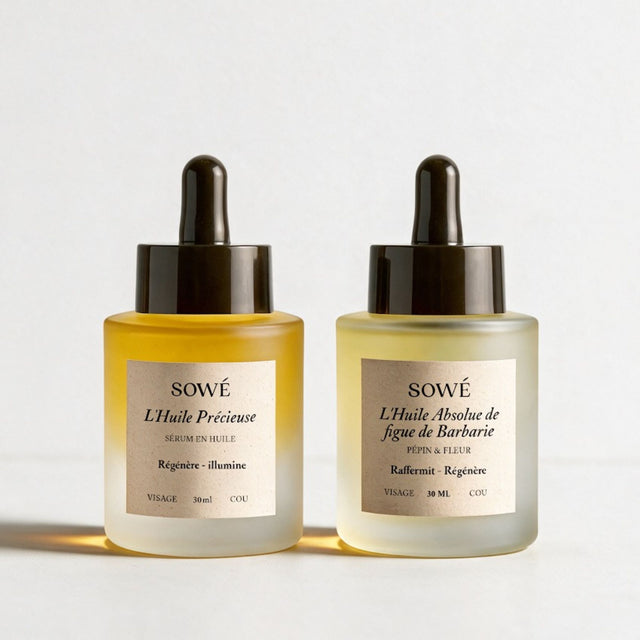
Our experts' choice: SOWÉ L'Huile Absolue prickly pear oil
An oil serum built around the Absolute Nopal Complex™: a pure prickly pear seed oil, from cacti grown in the Algarve, in which the plant's flowers have been macerated to bring the extraordinary benefits of phenols.
- Dry texture that absorbs quickly and goes unnoticed under make-up.
- Cold-pressed seeds, water-free formula, COSMOS Ecocert certified.
- Evaluated in the laboratory with CBIOS (in vitro tests).
How to recognise a quality oil?
Check five points: cold pressing, organic certification, opaque or amber bottle, a clear ingredient list (INCI), and a consistent price. For prickly pear, price is the first signal: a pure seed oil cannot be cheap.
The trap of fake prickly pear oils
Some “prickly pear oils” sold at low prices are in fact cactus flowers or pads infused in an ordinary oil, such as sunflower or soybean. They contain little or no seed oil.
The criterion to remember: the base must be seed oil. In the INCI, Opuntia Ficus-Indica Seed Oil should appear first. The presence of flowers is not a flaw in itself: it is the oil carrying them that makes the difference.
This is the principle of our Huile Absolue: a pure seed oil in which prickly pear flowers have been macerated.
Checklist before you buy
| Point | What to look for |
|---|---|
| Main ingredient | Opuntia Ficus-Indica Seed Oil or Rosa Rubiginosa Seed Oil, Rosa Canina Fruit Oil at the top of the list |
| Extraction | “cold-pressed” or “first cold pressing” (see what is a cold-pressed oil) |
| Label | recognised organic certification (COSMOS, Ecocert…) |
| Bottle | amber or opaque glass, dropper or pump |
| Scent | plant-like, never rancid |
| Origin | country or region stated |
For another way to enjoy prickly pear, also discover argan oil enriched with prickly pear.
Frequently asked questions
What is the best oil to rejuvenate the face?
No oil rejuvenates the face in the strict sense. A good oil nourishes, softens and improves the comfort of dry skin. The choice depends on your skin: prickly pear for a dry finish and morning use, rosehip for a richer evening treatment.
Is prickly pear oil good for the face?
Yes. Rich in linoleic acid, sterols and naturally occurring vitamin E, it nourishes and softens the skin without leaving an oily film. It suits combination skin as well as mature skin.
What are the contraindications of rosehip oil?
No contraindication has been established, but rare cases of contact allergy have been described. Test the oil on a small area before first use and throw it away if it smells rancid. If in doubt, if you are pregnant or if your skin is damaged, ask a doctor or pharmacist for advice.
Is prickly pear oil effective against wrinkles?
No oil erases wrinkles. Prickly pear oil nourishes the skin and improves the appearance of fine lines linked to dryness. A study by the Tunisian industry, unpublished and without a control group, observed improvements in skin relief after 28 days.
Sources
- Nounah I. et al. (2024). Effect of seed's geographical origin on cactus oil physico-chemical characteristics, oxidative stability, and antioxidant activity. Food Chemistry: X. doi:10.1016/j.fochx.2024.101445
- Kadda S. et al. (2021). Temperature and extraction methods effects on yields, fatty acids, and tocopherols of prickly pear seed oil. Environmental Science and Pollution Research. doi:10.1007/s11356-021-16752-8
- Kadda S. et al. (2026). Applications of Opuntia ficus-indica seed oil from eastern Morocco. Scientific Reports. doi:10.1038/s41598-026-41503-5
- Grajzer M. et al. (2015). Characteristics of rose hip (Rosa canina L.) cold-pressed oil and its oxidative stability. Food Chemistry. doi:10.1016/j.foodchem.2015.05.034
- Rincón-Cervera M.Á. et al. (2016). Vegetable oils rich in alpha linolenic acid… Prostaglandins, Leukotrienes and Essential Fatty Acids. doi:10.1016/j.plefa.2016.02.002
- Moreno Giménez J.C. et al. (1990). Treatment of skin ulcer using oil of mosqueta rose (article in Spanish). Medicina Cutánea Ibero-Latino-Americana. PubMed 2214931.
- Erdoğan Ü. et al. (2025). Green solvent 2-methyltetrahydrofuran improves recovery of bioactive molecules from oilseeds. Food Chemistry. doi:10.1016/j.foodchem.2025.143659
- Valerón-Almazán P. et al. (2015). Evolution of post-surgical scars treated with pure rosehip seed oil. Journal of Cosmetics, Dermatological Sciences and Applications. doi:10.4236/jcdsa.2015.52019
- Belkhelladi M., Bougrine A. (2023). Rosehip extract and wound healing: a review. Journal of Cosmetic Dermatology. doi:10.1111/jocd.15971
- Phetcharat L. et al. (2015). The effectiveness of a standardized rose hip powder… Clinical Interventions in Aging. doi:10.2147/CIA.S90092
- Ochando-Ibernón G. et al. (2018). Allergic contact dermatitis caused by “Rosa mosqueta” oil. Contact Dermatitis. doi:10.1111/cod.13083
- ANADEC / PAMPAT (UNIDO). The Tunisian prickly pear seed oil: study carried out in 2020, not published in a scientific journal.
- CBIOS, Universidade Lusófona. Evaluation of antioxidant activity and tyrosinase inhibitory potential of SOWÉ formulations: internal report, in vitro tests.


